
Big Shot Boxing

How Many Dudes?
12 Mini Battles
Getaway Shootout

How Many Dudes? Unblocked
Bomber Royale

Super Liquid Soccer




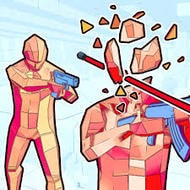









Time Shooter 2 reinvents first-person action by tethering the flow of time directly to player movement. This foundational principle recasts every firefight into a strategic tableau where deliberate positioning, foresight, and spatial awareness supersede raw reflexes. Players navigate tightly designed combat arenas saturated with adversaries, armaments, and interactive elements, meticulously orchestrating each motion to outmaneuver and eradicate all opposition.
At the heart of Time Shooter 2 lies its signature temporal manipulation. Absolute stillness brings the world to a perfect standstill, granting players the luxury to analyze frozen enemy formations, trace the suspended trajectories of bullets, and survey the tactical landscape. The simple act of moving forward jump-starts time, imbuing every stride, dodge, and weapon pickup with profound consequence. This architecture fosters a calculated, almost chess-like approach, richly rewarding those who can pre-visualize the chain of events their actions will unleash.
Time Shooter 2 arms players with an eclectic arsenal discoverable within each stage, where selecting the optimal tool for the moment becomes a critical strategic layer. Adversaries are intelligently stationed to exploit hasty advances, compelling players to seek flanks and leverage elevation. Often, clever utilization of the surroundings—ricocheting shots, hurling objects, or forcibly disarming foes—yields greater success than a straightforward assault, prioritizing tactical ingenuity over brute force.
The game structures its challenges as distilled, arena-like spaces built for experimentation and mastery. Initial levels gently onboard players into the time-bending dynamic, while subsequent stages weave together complex enemy synergies, weapon options, and hazardous terrain. Progression is earned not through character stats, but through the player’s deepening comprehension of timing, spacing, and enemy behavioral patterns, making each victory a testament to learned skill.
Time Shooter 2 offers a deliberately paced, cerebral action experience where victory is authored by patience and precision. By transforming time into a manageable resource, it compellingly argues for a more contemplative style of combat, inviting players to pause, scrutinize, and then execute with exacting intent—forging a uniquely rewarding niche within the first-person genre.
